

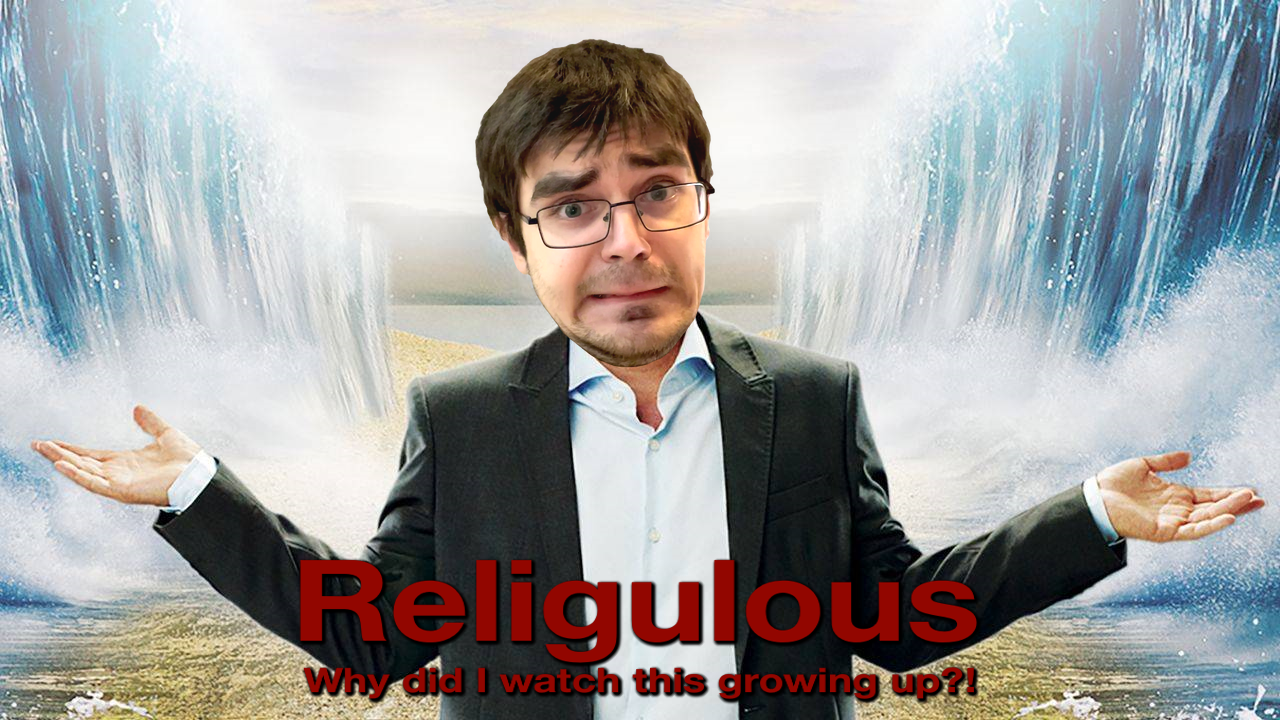
Religulous: The Documentary I Was Too Young to Watch
Thanks for all the closed-mindedness, Bill! To think I could’ve grown up watching Fraggle Rock instead!

CONTENT WARNING!
This post contains sensitive material that may not be suitable for all readers. The material in question includes:
- Disturbing true crime stories
- Religious issues
- Political issues
- Flashing imagery (for the epileptic)
- Terrorism and anti-Semitism
- Graphic violence
- Sexual and suggestive content
- Mentions of rape
- Mentions of homophobia
- Bad language
Table of Contents
Viewer Discretion Advised?
On the Road Again
A Conflict Between Good and Evil?
Viewer Discretion Advised?
If you read my last post here, you’d know that Shadow the Hedgehog was a game I spent a fair amount of time playing as a kid, only to rediscover it with fresh eyes as a Sonic spinoff that flourishes with creativity in service of immature, lackluster writing. Well, believe it or not, it took witnessing only a few seconds of the game’s chaotic, heat-packing startup sequence for my parents to decide I probably shouldn’t be allowed to play it for at least a few weeks. This detail would have you believe my family always took suitable caution with what they allowed their kids to see.
Right?
Well, for some ungodly reason (no pun intended), just days after setting this limit in place, I would be allowed to binge-watch episodes of Law & Order: SVU when everyone else in the family was. Now, considering the writing of Shadow the Hedgehog was, as I described in the last post, not a whole lot more mature than the writing of the previous games, not to mention the severe censorship that cut out any blood or especially bad language, the decision to withhold it from me due to its content only to then grant me permission to watch a grim, clinical crime series about sex abuse… well, in polite terms, was a little contradictory. It only raises more eyebrows to know that watching SVU extensively led me to become needlessly paranoid about the possibility of being molested by anyone anywhere at any time, and you can bet your ass that was spoken of at all my future therapy sessions.
Funny enough, though, watching SVU wasn’t even the strangest scenario! See, when I was eight or nine, my family became invested in a vulgar feature-length documentary that was well within the interest of a nonreligious family like mine… if only the third child, an impressionable eight-year-old autistic son with anger management issues, wasn’t granted permission to watch its full length on a regular basis. This documentary, as it were, was released in 2008, directed by Larry Charles, and aimed at recording popular political and religious satirist Bill Maher’s worldwide journey to understand why people of various cultures and religious groups rely so heavily on outdated theological systems with supernatural and mythological elements. If you can believe it, it would end up transforming me into an antireligious zealot throughout elementary school who would only begin to show some level of tolerance during his high school years. That being said, we’ll be getting into what’s by far the most graphic and taboo subject matter and imagery ever covered here, stuff that’ll make you seriously question how it must’ve affected me early on in life. Strap in, folks, ’cause this will be a bumpy ride! Viewer discretion is not advised, ’cause it sure as hell wasn’t when I was little!
On the Road Again
When it comes to dissecting a movie, game, book, etc. throughout one of these posts, it usually makes sense to cover the basic story up front before giving it a closer look with a more critical eye. This is exactly what I did with Shadow the Hedgehog in my last post, after all, along with Batman: The Killing Joke in my Joker and Harley Quinn post. Yeah, well, in this movie’s case, there’s a noticeable buildup from raising thoughtful and socially relevant questions to… well… apocalyptic fearmongering, as we’ll get to later on, so allow me to go over the events in chronological order and discuss each of them in detail as we go.
Before the point of no escape, though, let me give a brief disclaimer. While I am still, to this day, a devout atheist, the more radical views expressed in this film do not necessarily reflect mine, even though I do agree with some of them. Just keep in mind that these are arguments from a 2008 perspective—as in, well before the Trump era of politics—and that if you’re deeply religious or have trouble digesting hardline antireligious messaging, this post might not be for you. Then again, if you’re just happy to come along for the ride and explore this movie with me, you better buckle in tight, ’cause much like its crew on their road trip, there’s no turning back.
The movie opens with a tone that establishes the core beliefs behind it with minimal subtlety. Bill stands in the middle of Tel Megiddo, a national park in northern Israel that stands as the remnant of the ancient city Megiddo and site of an apocalyptic battle according to the Book of Revelation. The term “Armageddon” originates from the site’s Greek name, so Bill makes this the spot where he reflects on mankind’s newfound ability to destroy the world. He explains that, at the time that the Book of Revelation was written, only God was believed to have had the power to destroy the world, but that was before the catastrophic scale of intercultural tension and environmental damage that’s been demonstrated since. While this no doubt sets us up for a bleak ride, he does lighten the tone with a straight dose of his unrestrained irreverence.
“If there’s one thing I hate more than prophecy, it’s self-fulfilling prophecy.”
– Some guy who appeared on Johnny Carson forty years ago.

It’s a good thing he does, as the film is more humorous and satirical until… well… it isn’t anymore, and the precise editing with its comedic timing and abrupt cutaways certainly makes it so. It starts off with him on the road with Larry Charles, expressing his befuddlement that otherwise sane, rational, and intelligent people can still buy into the premise of, as he puts it, “drinking the blood of a two-thousand-year-old god”. His inability to comprehend this contradiction becomes the driving motivation for the documentary, with the meticulously edited intro credits sequence featuring “The Seeker” by The Who—yes, the same song from my lost media and beta content posts’ intro video—containing the same blend of smarmy-faced social satire and twisted sensationalist glimpses into the darker side of modern religious history as the rest of the movie onwards.
He does briefly break away from this with the subject of his own religious history, having been brought up by two parents who were separately Jewish and Catholic. As he interviews his mother and sister about what exactly happened to their family’s faith, he looks back on his childhood experiences going to church and his standup comedy days of lighthearted jabs at more bizarre religious practices like circumcision. In the modern day of 2008, however, he’s begun to ask real questions about people’s uncharacteristic willingness to accept biblical texts as the word of God and the implications it’s had regarding ignorance, corruption, hubris, war, and other dark aspects of human nature. Although he does have an early debate with Dr. Francis Collins of the Human Genome Research Project, a rare devout Christian in his field, this is intercut with a less professional segment featuring the attendees of the… and, no, this is the actual name… Trucker’s Chapel. His debate with the backwoods gentlemen he meets questions multiple Christian tenets—notably the Virgin Birth—that suspiciously aren’t included in the Bible aside from a limited number of the Gospels. While we do get one walk-out from a grubby older man, the debate remains as cordial as most interviews in the film, which I’d like to say is impressive, although each interview is clearly edited and therefore could’ve had its more argumentative moments cut out. Regardless, after the truckers pray for Bill, he thanks them for “being Christlike, and not just Christian” and accuses them of stealing his wallet before leaving. Time to get back on the road!

The next stop is a conversation with Reverend Jeremiah Cummings, AKA “Doctor”… although onscreen text states that he does not have a degree of any kind. Between the reverend’s (laughably weak) claim that Jesus was a wealthy man and Bill’s playful jabs at the salaries he supposedly gets from the church, the editing really goes full-throttle at this point, notably Bill posing a question regarding the reverend’s bandmate in Harold Melvin and the Blue Notes who was ordained a minister at ten years old: “What do you think it says about religion and how serious it is if you can be a minister when you’re ten?” The long pause punctuated by such a brief clip… let’s just say, text alone will not do it justice.
Yes, these interviews are heavily edited, but there’s a clear angle behind the documentary, so naturally, it has to be edited a little for the sake of that angle. After all, if it were more raw than it is, we wouldn’t have gotten this endlessly quotable cutaway.
Anywho, Bill takes interest in how Cummings was a Muslim, has become a Christian, and now wears his clothes like a Jew. Time to get behind the wheel again! This time, he gets into the story behind Sodom and Gomorrah, or more specifically the, errr… ass-backwards story of Lot and his meeting with two angels, in which he’s portrayed as a local hero for keeping these angels from getting raped by offering up his own daughters. Hey, speaking of attempted angel gang-rape and fathers pimping out their daughters, you know just what that’s coming next!
Homosexuality?
Yep, we’re getting into the rather unpleasant relationship between Christianity and sexual diversity, and despite the homophobic viewpoints of various politicians and “God Hates F**s” protests put on display at the start, what transpires afterwards is among the most satisfying parts of the film. Bill meets with self-proclaimed “ex-gay” pastor John Westcott, who runs a conversion therapy service, and as much as he tries to hide it, you’ll be saying by the end of the sequence, “Yeah… this guy is definitely still gay.” We get a montage of multiple gay pride parades, nods to Reverend Ted Haggard and his gay sex scandal, a three-second-long counterargument in the form of Dr. Dean Hamer confirming that he discovered the “gay gene”, Bill sarcastically pointing out that it “takes a lot of insecurity to walk out of the house with assless chaps”, a near-uncensored clip from a gay porno… wait…
“I was out birdwatching… but I’d rather watch you.”
– A rather risqué deleted scene from Brokeback Mountain.
It finishes off with a bang, with Bill complimenting the pastor’s looks, claiming that if he saw him in a bar, he’d say, “I think that guy’s gay.” It ends with the two of them sharing a long, hearty, incalculably awkward laugh together over the Brokeback Mountain theme and Bill noticing Westcott’s hard-on. Queue the end credits of Curb Your Enthusiasm.
The next interview takes us to a mannered ex-Jew for Jesus named Steve Burg, who recalls a “miracle” that involved him sticking a glass out a window and asking for rain, immediately after which a rainstorm started. Bill gets distracted by the price tags on porcelain Miranda statues and corrected on the biblical story of Jonah and the giant fish after he slips up and calls the fish a whale. That correction changes literally nothing, and Bill comments on how often he’s heard it in a cutaway. The interview ends with him telling Steve how low his bar for miracles is before moving on with the road trip. Next, he questions the belief that America is a “Christian nation” by referring to several of the Founding Fathers’ quotes that seem to contradict this.

The political fumes continue to spread as he meets with a devout Christian senator, who he chides about how a politician can believe in a talking snake (i.e., the serpent in the Garden of Eden). The senator claims that “you don’t need to pass an IQ test to be part of the Senate”, after which we get to watch every second of his slow, silent, and of course awkward self-realization at how moronic that came out sounding. Before that, however, Bill refers to the Ten Commandments and how the only two currently relevant laws in them are “don’t steal” and “don’t kill”, whereas we would’ve added many, many more if they were written today. Thus, we receive a montage of Bronze Age beliefs we’ve since abandoned over “I Ain’t Superstitious” by Jeff Beck.
Hmmm… I don’t remember those last couple… but they certainly make me feel sad.
We get one of the better sequences in the film, but it’s more effective in supporting Bill’s arguments than anything. It takes place at the Creation Museum and features the words of Abraham Lincoln… I mean, Ken Hamm, the man who broke new ground in the creationism community by deciding that… humans lived… alongside… dinosaurs. Yes, Mormonism and Scientology do have some tight competition in the realm of pot-smoking fiction after all. Luckily, Bill comes more prepared for his one-on-one with this nutcase than just licensing a three-second clip from The Flintstones. No, intercut throughout his Ken Hamm interview is another with Father George Coyne from the Vatican Observatory, who makes it clear that there’s simply too much historical distance between the biblical era and the era of modern science for there to be any compatibility between science and scripture. It ends with Bill telling Hamm that he is not, in fact, God himself, to which Hamm stares him down with a blatant, insatiable bloodlust in his eyes.
Speaking of the Vatican, Bill bad-talks the Pope’s famous palace in a clear state of defiance after getting thrown out of it on camera. He does meet with a crazy old Vatican priest who looks suspiciously like my therapist, though, before moving onto the next big exhibit—and trust me, it’s a very big exhibit.

The next major location is the now-abandoned Holy Land Experience, a theme park that was no stranger to controversy for supposedly proselytizing to Jews. Whoops. There, he meets the actor for Jesus himself at the park, who most certainly is not some lax hippie dude playing an ethnically inaccurate white Jesus. During the interview, “Jesus” tries to convince Bill that the breeze outside is God’s will, to which he just replies with, “Yeah, that’s the wind.” If you remember, I said the exact same thing in my Spirited Away video! Granted, I would like to look deeper into one especially strange aspect of the debates with the Jesus actor and other staff at the park, as Bill suggests that several deities from Hinduism, Egyptian mythology, and other centuries-old belief systems share a wide range of similarities to Jesus, including jobs as carpenters, raising the dead, walking on water, and coming back to life after three days. See, the Egyptian god Horus is given an entire montage sequence regarding the “coincidental” commonalities between him and Jesus of Nazareth, but from what I’ve read, the little credible information on Horus contains very few of these commonalities—he wasn’t born to a virgin, but instead by the grand deity Osiris using a phallus that was fashioned by his wife Isis. Any commonalities to Jesus have been heavily disputed since the late nineteenth century, and my guess is that Bill and Larry Charles just wanted an excuse to use “Walk Like an Egyptian” for something. Nevertheless, the Holy Land Experience segment culminates in a dour and moving live performance of Jesus’s crucifixion, with the brutality of the Roman army and a singer’s vocal talents on full display… until an airplane flies overhead, completely ruining the mood and resulting in plenty of awkward silence.
Now, this is where we get into one of the greatest scenes in the film and one of its most disappointing elements. That involves a belief system known by most for being among the most corrupt and bat-shit insane religions on the planet—one that started with a science fiction novel by L. Ron Hubbard. Yes, the film’s focus on Scientology spans nothing more than one live public recording and one noticeably out-of-place standup act by Bill himself, and while this feels far from worthy of the money-leeching cult that tricked celebrities like Beck and Tom Cruise into worshipping an intergalactic dictator, the first of these two scenes may be, without exaggeration, one of my favorite film scenes of all time. If you’ve ever wanted to see an undercover atheist enter a public park and preach the tenets of Scientology in front of a desperately confused crowd while “Crazy” by Gnarls Barkley thumps away in the background, then this is your lucky day, I guess.
If the Scientology segment feels horribly underwhelming, the following Mormonism segment practically multiplies the disappointment for being as extensive as it is. Now, sure, the Mormons also believe in fantastical science fiction concepts, and their history has been troubled by a disturbing ring of polygamy and pedophilia, but they’re barely even adequate competitors to the embarrassing, Xenu-worshipping scam that is Scientology. Besides, last time I checked, the Mormon Temple in Salt Lake City doesn’t contain a secret gulag-style work camp, so it has a lot to live up to in terms of theological insanity. I would much rather worship Bob from the Church of the SubGenius, thank you very much. When he proclaims that “there will never be enough women,” that’s a sermon I can get behind! Either way, the editor of this film thought it would be a fantastic idea to insert a brief religious porno clip into this segment, once again raising so many questions as to why I was allowed to watch it as a kid. In that case, you better be ready to ask pages of questions, because at this point, we’re heading into the territory of Europe and the Middle East. Prepare for mountains and mountains of terrorism, misogyny, anti-Semitism, Holocaust denial, and just a wee hint of Dutch cannabis worship! Good thing getting good and baked ain’t a federal crime over in Amsterdam! Oh, and also a kooky, flamboyant Puerto Rican weirdo who thinks he’s the Second Coming of Christ.

After a glorious scene of Bill being unable to fit a word in over the nonstop ramblings of a Holocaust-denying rabbi—an interview that somehow managed to show up in the final cut, whereas the nightmare that was the David Icke interview was too much to keep in—he visits an Israeli tech company devoted to developing phones and wheelchairs that basically exploit loopholes in the passage of “honoring the Sabbath by keeping it holy”. These are loopholes the documentary refers to as one epic, grand-scale fuck-up on the part of the authors of the Bible. As the head rabbi demonstrates the functions of these devices that narrowly defend their manufacturers from being legally beheaded, we’re shown brief cutaways of a fellow rabbi being repeatedly annoyed by the button-free phone dialing his number by accident, as well as Bill raising the burning question of why someone would want to go through the trouble of using a completely air-powered wheelchair for the god who took their legs away to begin with. Both are responded to with judgemental silence by the head rabbi.
However, between that and the man I’m about ninety-percent sure is not the Second Coming of Christ, the court proceedings of a mother who murdered her sons in the name of God in a way that echoed the story of Abraham are shoved into the mix because some people do some really bad things in the name of God sometimes.
Unfortunately, this is where we get into the topic of Islam, and no, that’s not because I have anything against it—it’s because, given the year of this film’s release and its antireligious aim, it naturally revolves around the violent recent history of the religion and the many jihadist groups associated with it. He interviews a Dutch Muslim politician who mostly just tries to place the darker passages of the Qur’an into the context of the time the text was written, and they bring up a filmmaker named Theo Van Gogh who was brutally assassinated in the streets of Amsterdam over his anti-Muslim short film Submission, which commentated on the unequal and often barbaric treatment of women in Islam. Again, please take some time to imagine eight-year-old me trying his damndest to get something of value out of this unholy nightmare.
To our luck, the graphic real-world content of the film has a number of comparatively innocent breaks in between, including a couple of topical conversations with British political rapper Propa-Ghandi and two gay Muslim activists who share the same smarmy grin like they’re seeing through Bill’s clothes with special x-ray vision. He makes a grand final detour to England, where he gives the audience a good, long look at the phallically erect Cerne Abbas Giant hill figure in Dorset, the exact origins of which remain unclear. His point in mentioning his fascination with it is that no one knows why they’ve been maintaining it for centuries… well, aside from its role as a historical monument, of course. It seems like something that’s done solely because it’s always been done, which to him is emblematic of religion in general (if you want more info on this nearly two hundred-foot chalk drawing, there’s a Wikipedia page for it here.)
“Sometimes, you kneel… sometimes, you fast… and sometimes, you go up on the hill, and you cut the grass around the giant space-penis.”
– Something I never should’ve quoted at school but did… a lot.
A tour of the Al-Aqsa Mosque in Jerusalem does follow, but luckily, it doesn’t get quite as deep into the war between Israel and Palestine as it does into the access of non-Muslims to the Temple Mount and the spiritual importance of the rare black stone composing the famous Kaaba. After the women’s pathetic little “special corner” is showcased, Bill explains the belief that the Jewish Messiah will lead their deceased followers onto the Temple Mount during the Second Coming, which is why Muslims have walled off the gate to the Mount. In his own words, on the other hand, “You’d think that if you had the power to raise the dead, you’d have the power to jump a fence.” So, I give the film credit for not drowning in nonstop misery and fearmongering… well, until the end, that is.
A Conflict Between Good and Evil?
It’s undeniable that Religulous is an extremely mature R-rated documentary, and the amount of graphic violence, sex, drugs, language, and all of the other content that one would consider inappropriate for a troubled eight-year-old (and that Shadow the Hedgehog utterly lacked in hindsight) is quite staggering. Even then, though, as you can tell by now, it tends to take a humorous and satirical approach more often than not, and the combination of the precise comedic editing and the rapport Bill establishes with his interviewees definitely cements it as such. So, sure, it probably wasn’t the best movie for an impressionable little kid like me to watch back then, but it wasn’t that much worse than, say, Family Guy or The Daily Show, which I also watched quite often at the time. Besides, we all see some questionable stuff at that age, don’t we? I often recall a couple of RedLetterMedia’s re:View episodes, where Jay and Rich revisit and discuss two bizarre sci-fi b-movies from Rich’s childhood—Spacehunter: Adventures in the Forbidden Zone and The Ice Pirates. However, Rich might’ve grown up knowing way too much about space herpes, but he never had to grow up with the final act of Religulous.
Overall, I think this movie is a quality comedic documentary, and minus the issues I’ve taken with the validity of certain points made throughout, I tend to agree with its arguments more often than not… so, with that out of the way, the final act and final argument both go off the rails like the ending of Zack Snyder’s Justice League times fifty. It’s one quote-riddled, opera-blasting, horrific imagery-infused, explosive, chaotic, hysterical, unrealistic, nightmarish, disheartening, traumatizing, apocalyptic montage of antireligious propaganda, although I feel like some additional adjectives could jazz it up further. Once the footage of his previous interviewees has been reordered to bring darker meaning to what they were really trying to say, Bill is left at Megiddo, the same location he started at. He returns here to propose that… brace yourself…. mankind has to be rid of all religion in order to avoid annihilation. It’d be easier to tolerate if it acted as a simple warning about how many atrocities have been committed in the name of God, but that’s not what happens. Instead, it acts as a call to action for (a) closeted atheists and agnostics to make their stances public, and (b) even the self-proclaimed moderately religious individuals out there to essentially pull their heads out of their asses. In his words, the danger that comes with religion is that it convinces people who don’t know all the answers to think that they do, which I would agree with from a sociological perspective, but that still doesn’t invalidate the counterargument I’m about to present.
It’s important to address what instantly takes his finishing argument off the table, and that’s from a perspective of pure realism. For context, let’s start out by assuming religion is the one true cause of everything wrong with humanity. Every crime, every injustice, and every inequality at any point in the future could be avoided if we can only learn to stop believing. So, with that assumption made, we have to ask: could that possibly be accomplished on a global scale? In blunt terms, no. No, religion will probably never be eradicated in its entirety because it’s made up the backbone of nearly every culture that has ever existed. Even in countries that set the separation of church and state in stone, religious and spiritual belief systems can be traced back to the earliest stages of civilization and have endured ever since. Stripping the world of religion would amount to stripping the world of a fundamental cultural building block—yeah, I disagree with others on anime, but I don’t believe it needs to die because liking it somehow makes you a pedophile. Besides, climate change is a human threat that’s come more front-and-center than ever since the film’s release, and the main obstacles in the way of fighting it are far more political than they are religious. Just take what the Pope’s had to say about the issue!
One of the saving graces of this documentary, even during the darker and more frustrating periods, is the soundtrack, given the usage of songs like “The Seeker”, “I Ain’t Superstitious”, “Jesusland” by Ben Folds (a much more realistic and level-headed commentary on religious issues), and “Highway 61 Revisited” by Bob Dylan. So, I’d give the film props for at least finishing on a more upbeat note with “Road to Nowhere”, one of my favorite Talking Heads songs, during the end credits… if only I didn’t get the impression the song was being recontextualized with a bleaker message than David Byrne intended.
Good lord, what the fuck happened with my childhood?!
Leave a Reply