

The Joker and Harley Quinn: The Easiest Couple to Get Wrong
Who needs the basic rules of morality, anyway?

CONTENT WARNING!
This post contains sensitive material that may not be suitable for all readers. The material in question includes:
- Disturbing true crime stories
- Mentions of graphic violence
- Bad language
- Mentions of sexual violence
- Political topics
- Suicide references
- Mentions of domestic abuse
- Alcohol use
Table of Contents
A Brief Testament to Cynicism
The Joker: Too Bleak or Not Too Bleak
Harley Quinn: Sympathy For the Devil
You Two Deserve Each Other
A Brief Testament to Cynicism
Before moving onto Max Payne 3 and my unexpected ability to relate to a miserable ex-NYPD detective, I’ve come to realize that I still have some cynicism and aggravation left over from the recent HuniePop post here. So, to relieve myself of that, I’ll be talking about a subject matter that I’m genuinely interested in, but mixed in with that are others that have been grinding my gears for a while now, a prime example involving yet another ditzy, ego-driven female monster the world’s chosen to admire and disavowe in spite of her heinous actions. So, let’s get down to business and shoot the breeze about the clown who blew Robert De Niro’s brains out on the air, the deranged killer DC decided to make a superhero, obscure villains from early 2000s platformer games, and child snuff film directors! Showtime, Batsy!
Oh, and much like the HuniePop post, this one is basically just a more detailed and higher-quality redo of a YouTube video. That video can be watched here, although I highly recommend sticking with this post instead.
The Joker: Too Bleak or Not Too Bleak
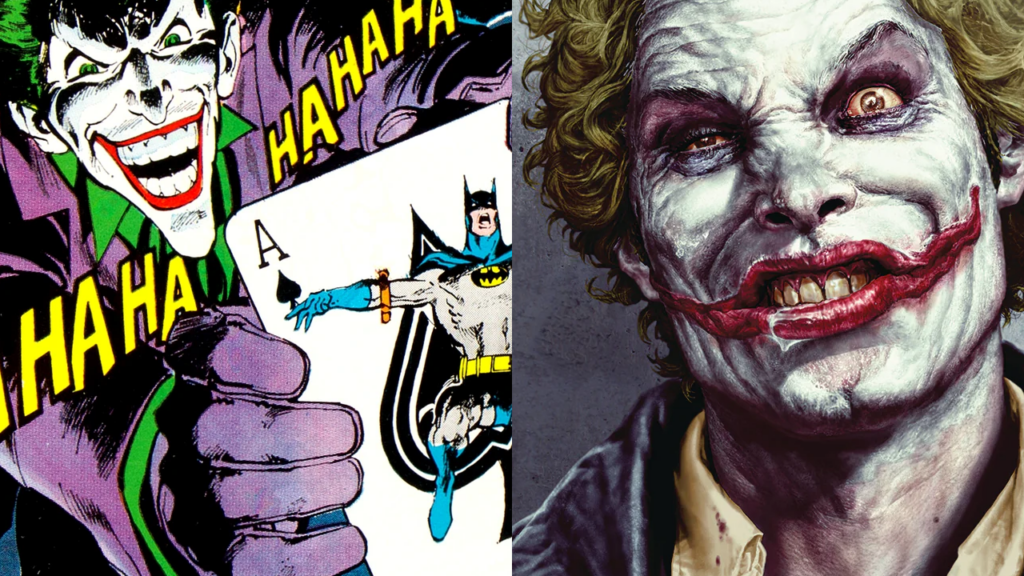
I make no claims of originality when I call the zany enigma haunting Batman like some malevolent specter among the greatest comic book characters of all time, but even that’s not an easy claim to make. Why, you ask? Well, in the worlds of DC and Marvel, the main timelines have been reset so many times, and the characters are reimagined so often, that calling a character one’s favorite just isn’t specific enough. For this reason, and given the fact that the Joker and Batman as a property are already approaching the public domain, there’s so many pages of alternate takes on them with such incomparable physical appearances and personality traits that I feel it’s necessary to explain who the character is from my point of view.
My take on the Joker based on what I enjoy (or fear) about him is as a desperate, egotistical wannabe entertainer. He wants nothing more than the spotlight and a permanent legacy, a madman without anything to prove who craves attention and control—whether it be positive or negative. Then again, my other reasons for liking the character go both deeper and more surface-level than that, so I’ll be starting with what he’s like on the outside. No matter how dark or twisted his actions or ideologies are, at the end of the day, he’s a soulless, shameless goofball of a Vaudeville performer. He has this jovial, childlike energy and a prideful, old-fashioned regality to him, like if Jackie Gleason lost his mind at clown school (in fact, it’s no coincidence that he’s quoted the Great One on several occasions in the Animated Series.) Besides, his humorous side is nonetheless representative of his darker side, as he sees everything in life, society, and human nature as one big, horrid joke, so it only makes sense (to him) to treat it as such.
Here’s where my interest in the character starts to deviate from many others’. The popular perception of Joker in comics, animation, and Hollywood films alike is as a human wrecking ball—yeah, he likes to put on a show, but the real goal? Just blowing a lot of things up. Whether it’s with a literal goddamn nuclear warhead or one from which he wanders away in a nurse’s uniform, it always feels a little, errr… stupid… to me? When executed in a way like The Dark Knight, it can sort of work if you remove most of the character’s inherent silliness, but I prefer to see villains like him involved in smaller-scale business. I mean, he can stick as many C4s to the foundations of corporate office buildings as he damn well pleases, but nothing tops the simple contrast and cruelty of his colorful ’80s depiction whacking poor teenage Jason with a tool from an auto body shop, and in a completely realistic manner on top of that. Moreover, I know exploring Alan Moore and Brian Bolland’s legendary 1988 publication Batman: The Killing Joke‘s a cliché at this point, but I do believe that (a) the mild controversy around it has been in denial of the point it was trying to get across, and (b) the way Tim Burton’s Batman reverted him back to a criminal without misfortune a year later overshadowed the more sympathetic twist this story sought to introduce, as great as that film was. To put it bluntly, The Killing Joke tried to elevate Joker above a simpler villain like Michael Myers, but unlike Rob Zombie’s Halloween, this attempt seemed to work.
The gist of this one-shot story arc is Batman going to Arkham Asylum to interrogate the Joker only to find a decoy in his place. After obtaining a defunct amusement park, Joker shoots Commissioner Gordon’s daughter Barbara through the spine, kidnaps Gordon, and holds him within the park while attempting to rid him of his sanity. While he ultimately fails, his goal is to show Batman that no one in the world is of a greater mental standing than his, that all it takes for anyone to lose their grip on their own sense of control is one bad day. It ends with a rare moment of understanding between the two enemies, with both of them laughing together for the very first time… and an ambiguous twist. It’s believed by many, including DC writer Grant Morrison, that Batman kills Joker at the end by snapping his neck, hence why his laughter continues but Joker’s ends abruptly. It’s even foreshadowed in the very first scene, that being Batman leveling with Joker during his visit.
“I’ve been thinking lately about you and me… what’s going to happen to us in the end. We’re going to kill each other, aren’t we? Perhaps, you’ll kill me. Perhaps, I’ll kill you. Perhaps sooner, perhaps later.”
– Ouch.
DC making this story arc canon aside, I don’t necessarily believe (or like to believe) that this is the way it ends. It could be seen as an intriguing “what if?” of Batman becoming tired of his unending battle with Joker and giving the sick bastard one last chance to end it before he does the deed himself, but because he expresses his desire to understand him early on, I think letting Joker live at the end fulfills this desire in a more meaningful way. To explain this, we need to dissect the titular “killing joke” the story concludes with. Trust me, we’ll be getting to the pretty psychiatry intern the bleached sicko hooks up with.
Using match cuts at various points in the story, Joker’s past life is pieced together. Instead of starting off as a seedy mobster with a red dome on his head, he was just a troubled working man seeking a career in standup comedy after quitting his job at a chemical plant, now that he and his wife were expecting a kid but unable to pay the rent. He agreed to help two mobsters rob a trading card company by guiding them through his former place of employment, but under a freak occurrence related to her pregancy, his wife died on the day of the robbery. He was forced to wear the disguise from his initial 1951 origin—it’s implied here that Red Hood was killed by the two mobsters—both grunts were shot dead by security, and he narrowly evaded Batman by tumbling into a runoff pool infected with chemicals. He crawled his way out, took a peek beneath his hood, and broke down at the sight of his reflection… then stood up… then hobbled away… then started to giggle. And laugh. And laugh. And laugh even harder as the final flashback concludes.
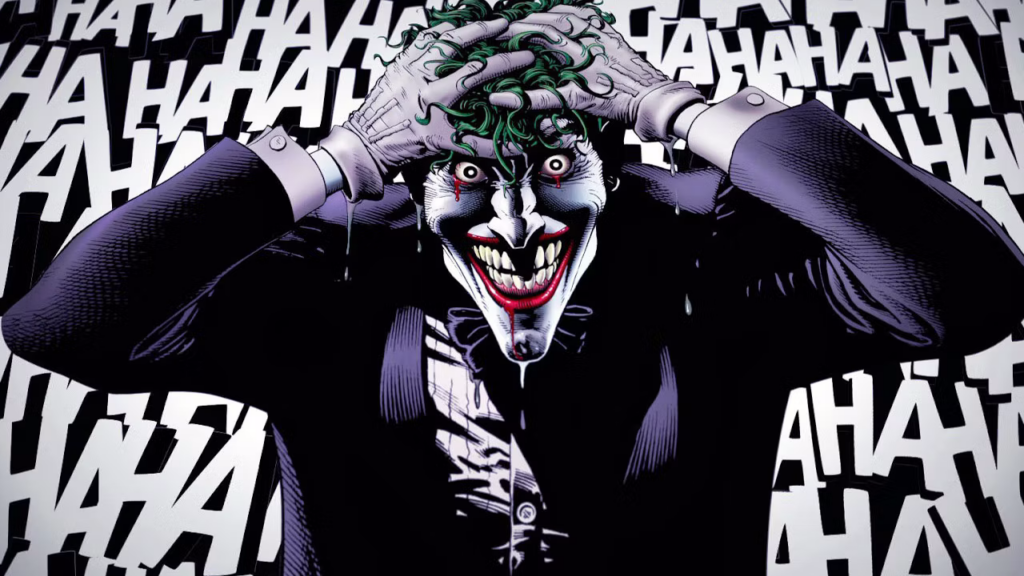
Now, what the fuck does this have to do with the “killing joke”? Well, at the end of the story, when Batman gives him an opportunity to give up his life of crime, Joker claims with uncertainty that it’s far too late, only to then recall a favorite joke. The humor behind the joke and the punchline are obvious, but dissecting it further leads to a goddamn mountain of symbolism. It could very well be one of the most brilliantly thought-out pieces of writing in comic book history.
“So, there were these two guys in a lunatic asylum. They decide that they don’t want to live in an asylum anymore, so they agree to escape together. Once out, they climb onto the roof, and across this small, narrow gap is a row of rooftops stretching out into the moonlight—into freedom! The first guy jumps across without issue, but the second doesn’t dare jump across because he’s afraid of falling, you see. The first guy gets an idea. He says, ‘I brought my flashlight with me! I’ll shine the beam to your end, and you can walk along the beam and join me!’ The second guy just laughs and says, ‘What do you think I am, crazy? You’d just turn it off once I’m halfway across!’”
– A true gentleman and scholar. And I’m of course talking about Alan Moore.
It doesn’t take much thinking to tell that the two guys mentioned are Batman and Joker, but it goes so much deeper than that. The small gap represents our hurdles in life, and the row of rooftops is the road to success. Batman is the one who finds it easy to make it over the hurdles, whereas Joker is too afraid of falling into the abyss. Batman offers to help him across, but Joker refuses to trust him because he also fears betrayal. Even then, though, the concept of the flashlight beam and walking along it is obviously crazy, so one might assume that Joker considers it impossible as anyone else would.
To me, on the other hand, the greatest and most hidden insight into Joker’s way of thinking can be seen both within that part and the punchline itself. The part that gets you is the very end, as the second guy doesn’t actually think walking along the beam is crazy—what he thinks is crazy is the idea of walking along the beam without being betrayed halfway across. So, what this seems to say is that Joker does believe deep inside that he can still be helped, but he’s constantly in denial due to never having been able catch a break. So, if the story ends with Batman simply laughing alongside him, knocking him out, and bringing him back to Arkham, it’d be a more satisfying ending for both characters. Batman, seeing clearly into the deeper meaning behind this joke, is finally given the better understanding of Joker that he’d always lacked, thus making him more comfortable with keeping the cycle of escape and incarceration going. Why am I not shocked that these ideas came from the same author who claimed that a love for superhero comics leads to infantilism?
So, why does all this information matter? Well, here’s why: it’s one of the only times in more than eighty years that Joker’s been given much of any psychological complexity. As irredeemable as he is, this makes the level of sympathy given to villains like Harley and Mr. Freeze by comparison a little bothersome, considering all the egregious crimes they’ve willingly committed—they’re really not a whole lot better than Joker. It really does seem like few adaptations other than some of the Arkham games and Todd Phillips’s Joker have stuck to what Alan Moore played his hand at back in ’88. Then again, most other people might be content with that, because The Killing Joke has become surprisingly controversial for reasons I’ve yet to make sense of. Although Barbara was never the primary focus, that seems to be where everyone’s minds have been, as her injury and horrid treatment at Joker’s hands have been criticized by even Moore himself as an insensitive plot device.
Why? Well, after being shot, Barbara’s stripped nude by Joker and photographed, and these photos are later used to psychologically torture her father at the amusement park (again, simpler plots like this tend to work much better for me.) Now, aside from the book’s release during an era tainted by the brutalization and objectification of women—along with my general disagreement with the theory that Joker goes as far as raping Barbara—you thankfully never get to see Barbara stripped down, as Joker simply starts unbuttoning her shirt before the scene cuts away. Compare that to Gordon’s treatment, in which case we get to see him stripped down in detail, left shivering in the nude, locked in a cage, and gawked at by circus freaks. The way Barbara’s treatment is presented clearly aims to direct sympathy towards her as opposed to any cheap shock value or exploitation, an intent that’s made abundantly clear in the heart-wrenching exchange between her and Batman in the hospital shortly after. After all, fans have refused to thank The Killing Joke for her new identity as Oracle and the co-founder of the Birds of Prey when it’s so obviously a case of her bouncing back from such a horrifying experience, so it’s apparent to me that we either get something tragic and moving like this or the more modern Captain Marvel, Ms. Marvel, and Black Widow syndrome of never getting hurt and consequently becoming a boring character. I’d take Barbara’s character development any day of the goddamn week.
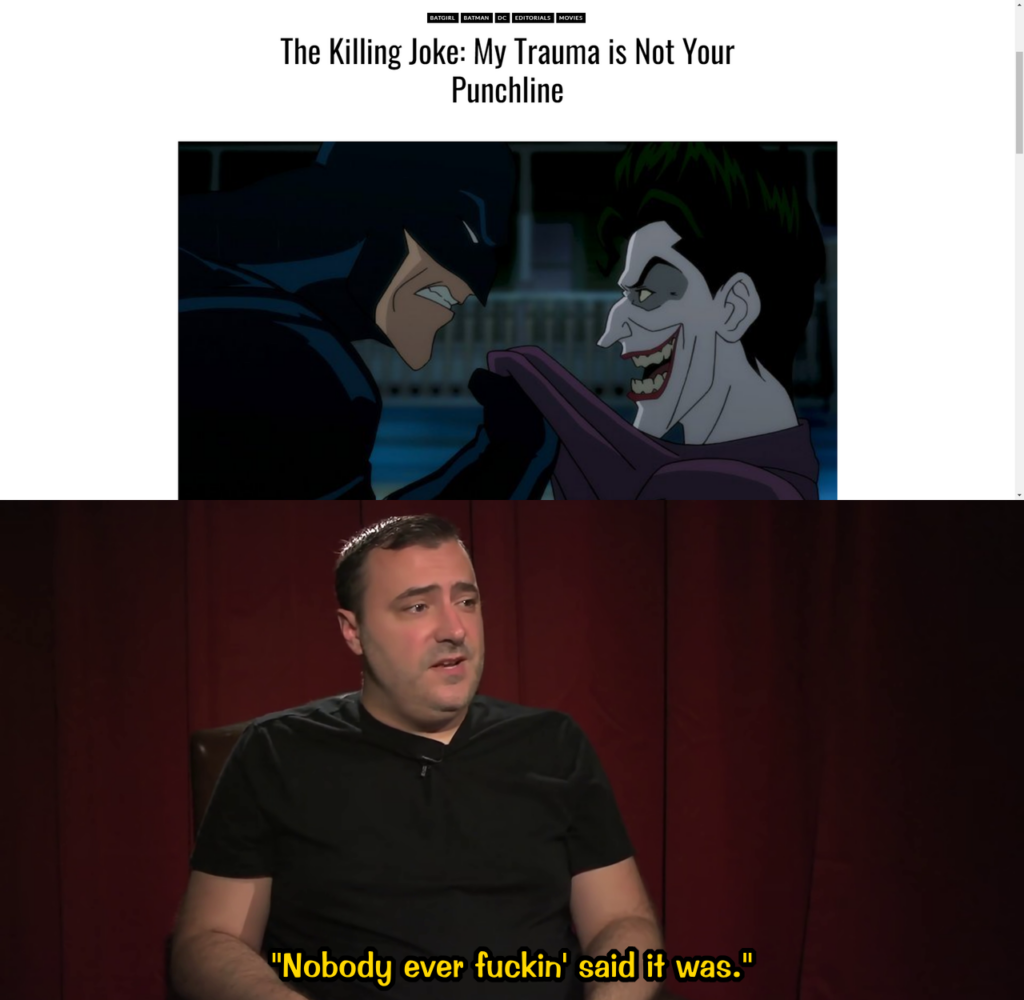
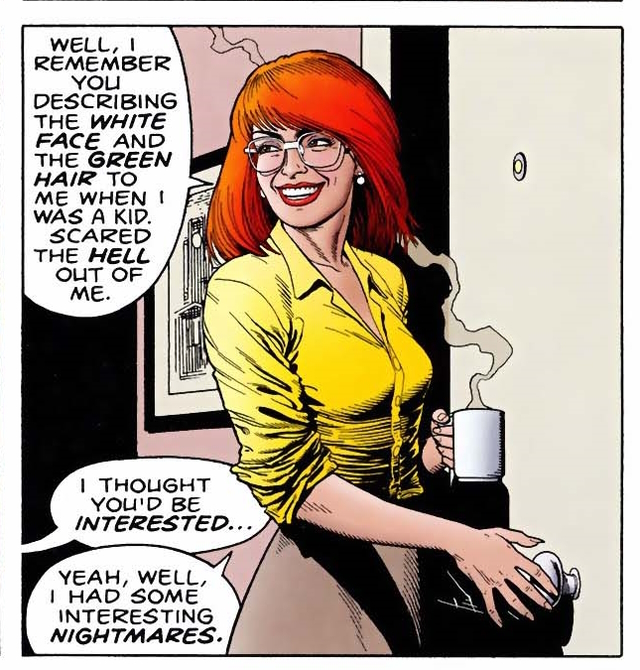
Oh, and for reference, when I claim to love the 2008 remaster of the comic but not the animated adaptation, it’s not necessarily for the short story written by Bolland after the former or the expanded pre-story on Batgirl in the latter. I just think the anime-inspired modern DC animation lacks the stunning realism within the comic’s art style and the expressiveness of the characters, notably Barbara’s lovely, radiant smile and subsequent shock and agony during the whole break-in scene. Same goes for Joker’s unbearable shame and despair in his flashback scenes.
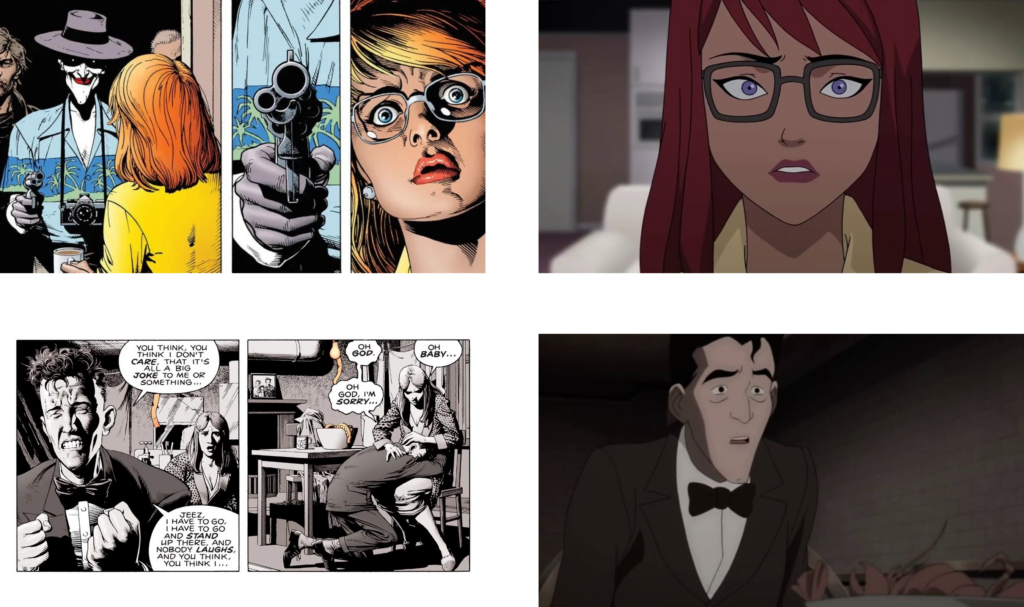
Just in case you forgot at any point in that dauntingly long spiel about a forty-year-old comic book, I stated that I see the Joker in a very specific way: as a pretentious, controlling prankster who contrasts directly with Batman’s bitter stoicism. Well, see, most writers, artists, and filmmakers have their own unique ways, and I’ve naturally taken issue with some of them—even the more popular ones. Shocking! I’m thankful every time I get to hear Mark Hamill either ham it up in animated iterations or read Trump tweets in his Joker voice (the latter of which has been gloriously done by Kevin Conroy in his Batman voice, God rest his soul), and I can at least give all of the main canon timelines credit for maintaining a healthy balance between his twisted sadism and shameless silliness for the most part. When we get into the live-action iterations, on the other hand… they also have, for the most part, but a couple popular instances have left me heavily conflicted, and it doesn’t just apply to Joker.
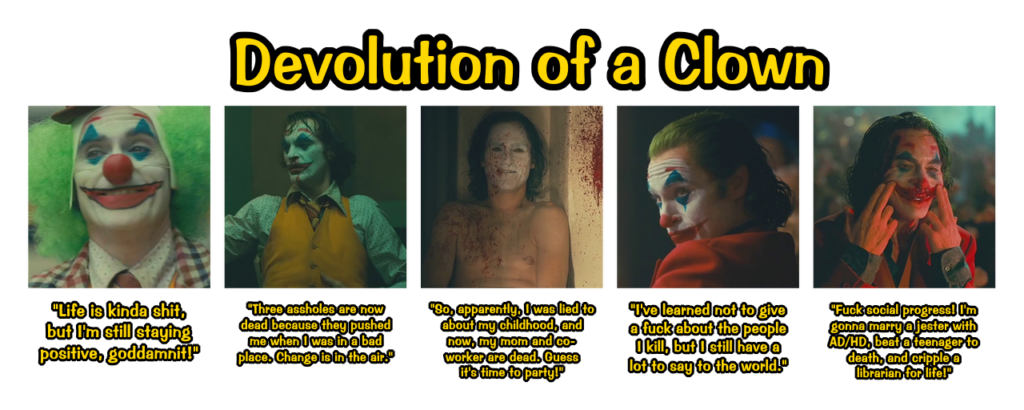
To me, most of the live-action Jokers have succeeded in maintaining that critical balance while also appropriately representing their eras. Caesar Romero minimized any real-world darkness and depravity without sacrificing the character’s cruel comedic shenanigans in true Silver Age fashion; Jack Nicholson brought a creepier Dark Age feel to the character while offering plenty of childish playfulness; and Joaquin Phoenix somehow managed to blend a troubled working man like Travis Bickle from Taxi Driver together with the bad joke-spewing showman from the main comic timelines and The Animated Series. In fact, there are far more bits of levity and dark humor than in his Killing Joke backstory, making for the perfect tone for a Joker origin story. Considering he’s depicted as a mentally and financially unstable aspiring comedian, the 2019 film is pretty faithful to Alan Moore’s masterpiece in a surprising number of ways. You have his deflated reaction to his mother’s Arkham patient file, which is pretty much identical to his reaction to his wife’s death in The Killing Joke; his mention in Sophie’s apartment before coming face-to-face with his delusion about their relationship that he had “a bad day”; and (spoilers!) the ending, which leaves open the possibility of his true backstory remaining unclear.
“My past… well, I’m not exactly sure what that is. Sometimes, I remember it one way, sometimes another. If I’m going to have a past, I prefer it to be multiple choice!’”
– More divisive and sometimes highly paranoid wisdom.
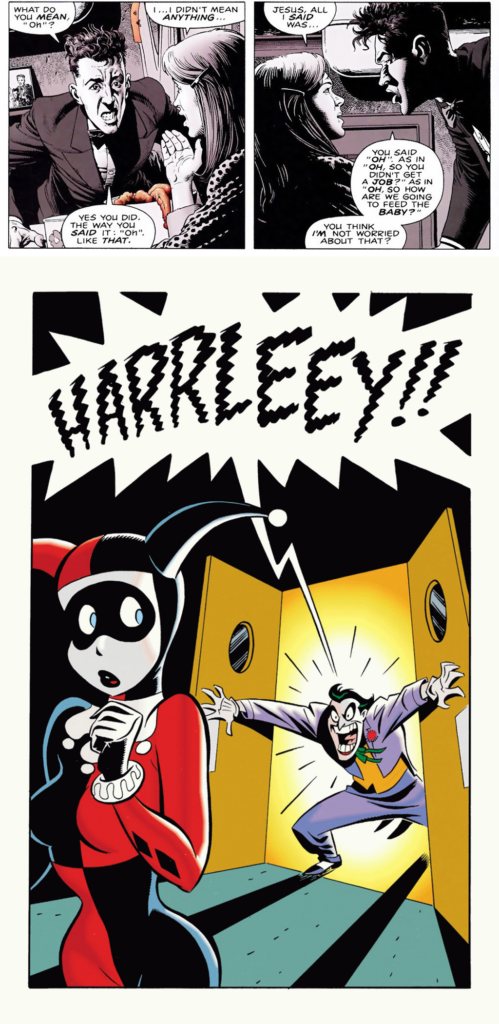
For those confused about the “mentally unstable” aspect of The Killing Joke, Joker’s mental illness isn’t explicit like it is in Joker, but his nervous, uneven dialogue and tendency to lash out at his wife over very little certainly implies it to some extent.
You didn’t think I left out one live-action interpretation on accident, did you? Nah, see, I often stress the associations between Heath Ledger’s Joker from The Dark Knight and the one by Lee Bermejo, one of my favorite DC writers and artists in recent years, throughout such breathtakingly written and illustrated comics as Joker (no, not that Joker), Batman: Noël, and Batman: Damned. It’d be objectively blasphemous to insinuate The Dark Knight isn’t a well-made film from a production standpoint, Ledger plays the villain with chef’s kiss perfection, and Bermejo has done more to expand on the character of Batman himself than most other writers. Yet, I still fail to see the Joker I know in either iteration, and I generally take issue with much of the Christopher Nolan film’s plot. Putting aside Batman’s choice to investigate crime in Hong Kong, the rushed way in which Harvey Dent turns on Gordon, and other storytelling oddities, Ledger pretty much amounts to a goth anarchist who seems more focused on sending a message about society than having any fun in the process—the latter’s clearly a major motivation of his in The Killing Joke despite the message he’s trying to send. The best way to describe his scenes is that they’re absolutely masterful in a general cinematic narrative sense, but if you know the character, that becomes all you think about while watching them.
Sorry, Redditors, but it’s practically impossible to avoid comparisons between Heath Ledger’s Joker to Joaquin Phoenix’s. Just take the latter’s glamorous entrance onto The Murray Franklin Show versus the former’s into the corporate party, and the amount of charisma and energy that Phoenix expresses as he basks in the limelight instantly deflates the oblivious way that Ledger wobbles in like a drunken wino. Yes, the execution of the scene from the Nolan film was clearly intentional, but it’s totally at odds with what the character would actually do. Funny enough, a common issue people take with Joker is that it whittles a callous criminal mastermind down to an emotionally disturbed loner with an average or below-average IQ… despite the fact that it features him using a violent protest and a stolen usher’s uniform to sneak into a private theater screening. He later follows this up by using a protester’s clown mask and starting an ensuing brawl to escape the police, proving that he is in fact intelligent and capable of the character’s trademark trickery and escape artistry. Moreover, it’s true that Phoenix seems to use The Murray Franklin Show as a vessel to vent his frustrations, but the way I’ve always seen the film, his transformation into the Joker isn’t quite complete at that point. It’s after he (again, spoilers!) ends the show with a bang that he’s solely out for blood, completely devoid of anything else to prove to the world, and the “blood smile” scene at the end is basically his crowning moment as the Clown Prince of Crime, now that he’s surrounded by his loyal subjects.
Ah, but who cares? I was just glad to see Batman get mental illness right for a change.
Well, okay, I suppose there’s still a couple of points to address about Ledger’s take, one of them being about the famous money-burning scene. Again, it’s near-perfect from a filmic perspective, but when it comes to the character of… you know… the Joker, it’s just plain baffling. Joker should never, ever, in a million years, set a heaping pile of cash ablaze only to then give direct and grim orders with a straight face. One might imagine him humming “Tequila” while jigging around the fire and spouting some horrible pun. Then again, considering how out-of-place a phrase like, “Ever seen money burn on the screen?” would’ve been, let me finish this paragraph on an impartial note by crediting the scene with inspiring one of the earliest sequences from ElectroVerse: Batman, a Batman comic line I’m currently writing. The only difference is that it’s Batman burning a pile of cash with a straight face because it works far better for him as a form of psychological warfare. Hey, it’s a tossup between that and letting Two-Face drop fifty feet to his death!
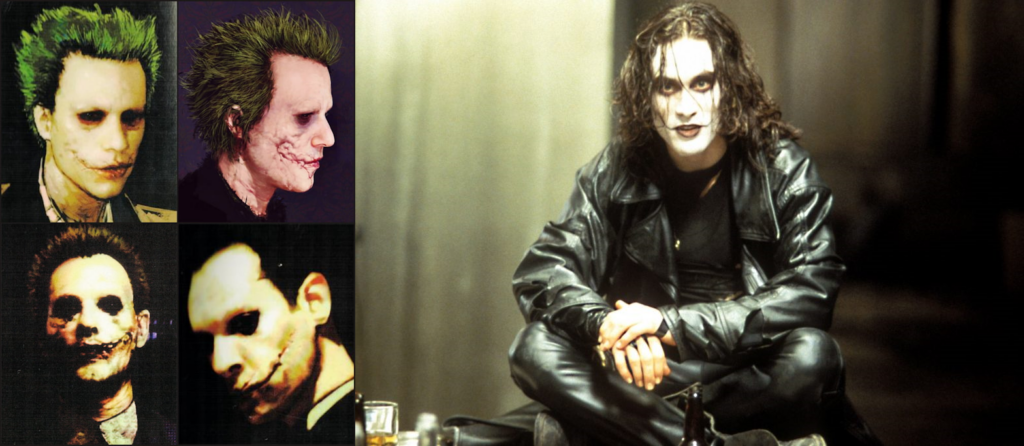
Now, the second argument came to me more recently and truly reflected the scope of how well-developed but fundamentally inaccurate this version of the character is. I caught my sister watching The Crow a couple nights ago, and seeing Brandon Lee in it for the first time, I had a brain-melting epiphany: backstory and special abilities aside, Heath Ledger basically borrowed the appearance and performance of the titular vigilante beat-for-beat. It was genuinely shocking how close the two of them were in terms of their gloomy goth aesthetics and darkly playful energy, although that did leave me more heavily conflicted than ever on why, aside from the makeup and desperate need for destruction, this was seen as the perfect inspiration for a live-action Joker. What made this confusion that much more palpable was my discovery of early design concepts for The Dark Knight, which displayed a haunting but far more original iteration that essentially melded Joker and Scarecrow into one villain. Sure, Joaquin Phoenix’s Joker can be chalked up to more or less just Robert De Niro from both Taxi Driver and The King of Comedy combined, but that (a) captures more of the overall energy and spirit of the character, and (b) fits the angle of showing how the Joker devolved from a marginalized pauper to a raving revolutionary to a remorseless maniac.
This is still a post partially about Harley, by the way.
Okay, I think I’ve blasphemed against a deceased actor’s beloved role one too many times already. Let’s switch gears to the Clown Princess… I mean, the lovably spontaneous agent of chaos, lover of Poison Ivy, and sadistic accomplice-turned-feminist icon! Did I mention that I currently have the tip of a raging bull in my mouth?
Harley Quinn: Sympathy For the Devil
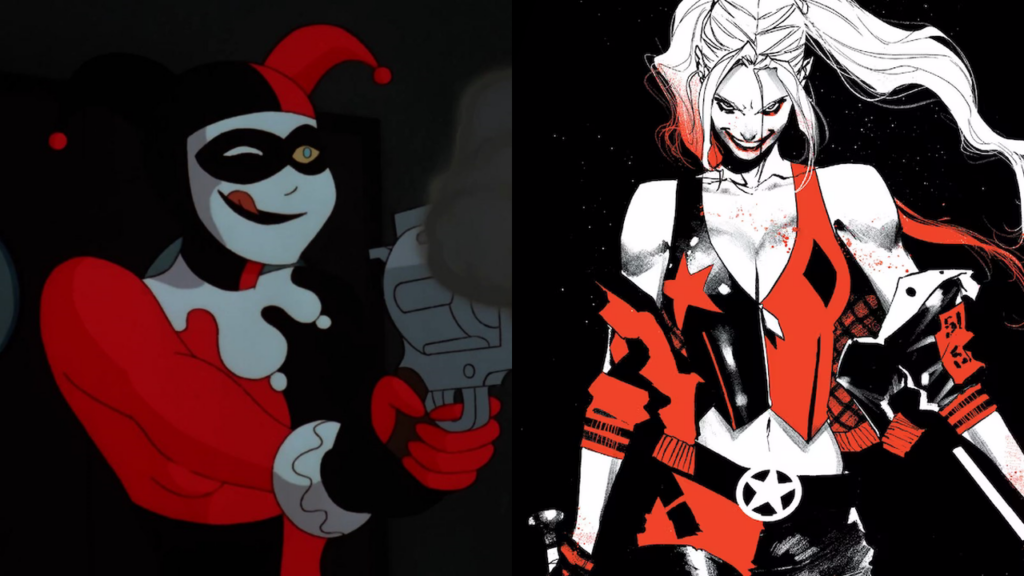
It’s appropriate that I offered a minor nod to Michael Myers earlier on in this post, as, if all of the Halloween movies since the Rob Zombie reboot have taught us anything, it’s that certain stories and characters work best on a basic minimalist level. In Michael Myers’s case, it’s because he’s nothing more than a silent, walking force of evil and savagery. In the case of Harley Quinn… it’s because she’s nothing more than a whiny, summersaulting force of evil and savagery. Well, kind of. Like Freddy Krueger in A Nightmare on Elm Street 3 and onwards, Joker and Harley are admittedly both fun to watch, but at the end of the day, they’re still crazed fiends you shouldn’t be rooting for. Now, in this day and age, it’s preposterous to insinuate that a female character is made solely who she is by her male lover, especially when that male lover is an abusive monster who adores his own arch-nemesis on a far deeper level. Well, this schmuck might not be goin’ “anti-woke” anytime soon, but he is insinuating exactly this with Harley because anything that’s genuinely interesting about her on a psychological level involves Joker in some capacity.
I mean, just to hammer this point home, Paul Dini made it clear that she was pulled straight from the kooky jester iteration of Arleen Sorkin’s character Calliope Jones from Days of Our Lives (God rest her soul, as well), but whereas she was simply playing a ditzy female jester in the sequences he referenced, Paul made Harley a twisted killer who was expressly described as having a sick infatuation with her lover… and then, he gave her the same wholesome antics as those of her predecessor. More than anything, he made it clear that he simply didn’t know what he wanted the character to be, and that garbled vision has permeated all the way through Rebirth and modern DC in general. Then again, this is the case pretty much entirely because Paul was close friends with Sorkin in real life, which—aside from the whole anomaly of her portrayal making perfect sense to me all of a sudden—would make him the Rob Zombie of animated showrunners. If he and Sorkin didn’t mesh well with the right material, that is.
To this day, the general association between Harley Quinn and Joker as a murderous couple lives on because that was the foundation she was built upon in The Animated Series: as a blindly loyal accomplice to a mass murderer. She was always treated as such until overindulgent crap like “Harley’s Holiday” started to come about, which has quickly become one of my least favorite Animated Series episodes despite its popularity. First off, I’m still annoyed by all of her antics in the episode “Harlequinade”, in which she works with Batman to stop Joker from launching a nuclear warhead, but I appreciate the fact that Batman constantly remains wary of her loyalty at all times, and he’s ultimately right for doing so: turns out, she’s been planning to break her loyalty all along! Second of all, “Harley’s Holiday” concludes on such a cute note of Harley promising to retire from her life of crime… only to end up returning to her old ways with Joker within a matter of episodes, proving that she can never stay true to her word and therefore cannot be trusted. I mean, even when putting that aside, trusting her is already an expectation on shaky ground when she’s the same lunatic who forced unbearable pain upon an innocent dock worker using Joker gas in “The Laughing Fish”; sent an unknowingly innocent outcast down a conveyor belt into a smelting pit in “The Man Who Killed Batman”; and would’ve sawed Catwoman’s goddamn head into thirds in “Almost Got ‘Im” if she was competent enough to keep the shutdown switch hidden from Batman. So, not only is she a murderer, but she’s also a moron!
Hold on, sorry. We’re gonna have to upgrade. Wait here while I swap this revolver out for a hunting rifle.
Okay, great. If the round itself doesn’t do the job, the recoil should. I get the strong feeling Harley fans would argue that all of her past actions were Joker’s orders—in which case, she’s at fault for following them without question—along with my favorite moral statement of them all: the claim that “her entire life was stripped away from her”. No offense to them, of course, but the people who repeat this statement are doing so from one of two perspectives: (a) her backstory from the New 52 and onwards, or (b) a fundamental misunderstanding of her original “Mad Love” backstory. See, it’s set up at the very start of her original backstory that she has an abnormal attraction for the criminally insane, and for reference, it’s never specified that Joker ever uses this to his advantage. He tells her that he’s heard a lot about her, although how word has traveled about some fledgling psychiatry intern is beyond me. The second their first therapy session begins, he jumpstarts this long tangent about his abusive father—the same type of fake backstory he spoon-feeds to all the other doctors at Arkham, as Batman points out to her later in the storyline. Considering Dr. Quinzel must have access to his patient file, which surely notes this as part of his M.O., she doesn’t have many good reasons to give in like a weak twig and take his word for it. However, she does exactly that, starting by laughing at his punchline to the point of tears and eventually attempting to clear him of all wrongdoing in her own head. As for when she goes to him about how crazy this is, why she’d even seek assistance from a known killer to begin with as opposed to professional help from any of her fellow doctors feels like just a logical mistep on her end. In my video, I put this aspect of her backstory in a way that hopefully won’t be seen as offensive, which was by comparing her logic to requesting dieting tips from a known diabetic.
Basically, what I’m trying to get across here is that there was little to no actual manipulation going on between the two—Harleen Quinzel was the wrong intern in the wrong place at the wrong time and formed a dangerous, obsessive infatuation with a feared psychotic crime boss. Yes, she was gullible and therefore an easy target, but she was also given more than enough reasons as a professional in both her position and her chosen career path to steer clear of his… well, I’m sure she would call them “charms”, but frankly, I have no idea what I’d call them. To further clear the air, they were undoubtedly involved in a codependent relationship, but like in other relationships of the sort, she was an equally unhealthy contributor to the overall dynamic. As for her New 52 backstory, I’ve always seen it as a well-developed but unnecessary excuse to make her more of a tragic, misunderstood villain (or antihero, even) because her previous origin just said too much about her irrational and unpredictable nature. I mean, it certainly said more about her than it did about Joker, after all. Her old backstory simply demonstrated this too much if readers were going to direct their sympathy towards her… even though she was, by all means, a supervillain.
Now, here’s where I really start to strain my mental capacity for analyzing nuances in characterization, because when I joked about the abandonment of “the basic rules of morality” in the subheading of this post… well, this is where that comes into play. Now, I just tried explaining why a dangerous criminal like Harley Quinn doesn’t necessarily have to be sympathized with despite her abusive relationship with Joker, which I think is still hard for the fans who love her for her kooky, childish antics to buy into. I mean, first off, like I said in my video on these two, comparing her and Joker’s romance to real-life abusive relationships is basically offensive to the victims of those relationships, as those are usually innocent women who are genuinely unsure of whether their partners are heartless monsters or good people with serious emotional issues. They are not murderous sadists who willingly wreak havoc and death alongside their lovers.
Regardless, this is where I get into three comparisons to Harley in particular, two of which are quite strange but nonetheless relevant and telling in context, and I even mentioned the third to be discussed here in my video. The first one, however, is Mr. Freeze, a character who went from corny and dated to symbolic and tragic in the early ’90s. What I appreciate about the famous Animated Series episode “Heart of Ice” is that, despite the sympathy it builds for the character who admittedly made it famous in the first place, Victor Fries is no innocent man. This is made clear when Batman asks him if he’s willing to kill everyone at Ferris Boyle’s gala ball to either get his wife back or avenge her trying, to which he nods and delivers a truly chilling line. Don’t leave. That’s the last pun. Please don’t make me pull a Kurt Cobain with this thing.
“Think of it, Batman: to never again walk on a summer’s day with a hot wind in your face and a warm hand to hold. Oh, yes… I’d kill for that.”
– A sad, dishonored man who’s also G-U-I-L-T-Y.
So, yeah… a tragic villain is still a villain because their actions don’t justify their means. Same goes for Killer Croc in spite of his childhood of neglect, freak show career, and in the ElectroVerse, feral upbringing. Being treated as less than human because of a skin and growth condition is cruel and unfair, but still not quite enough to justify cannibalism. I think we can all agree on that one.
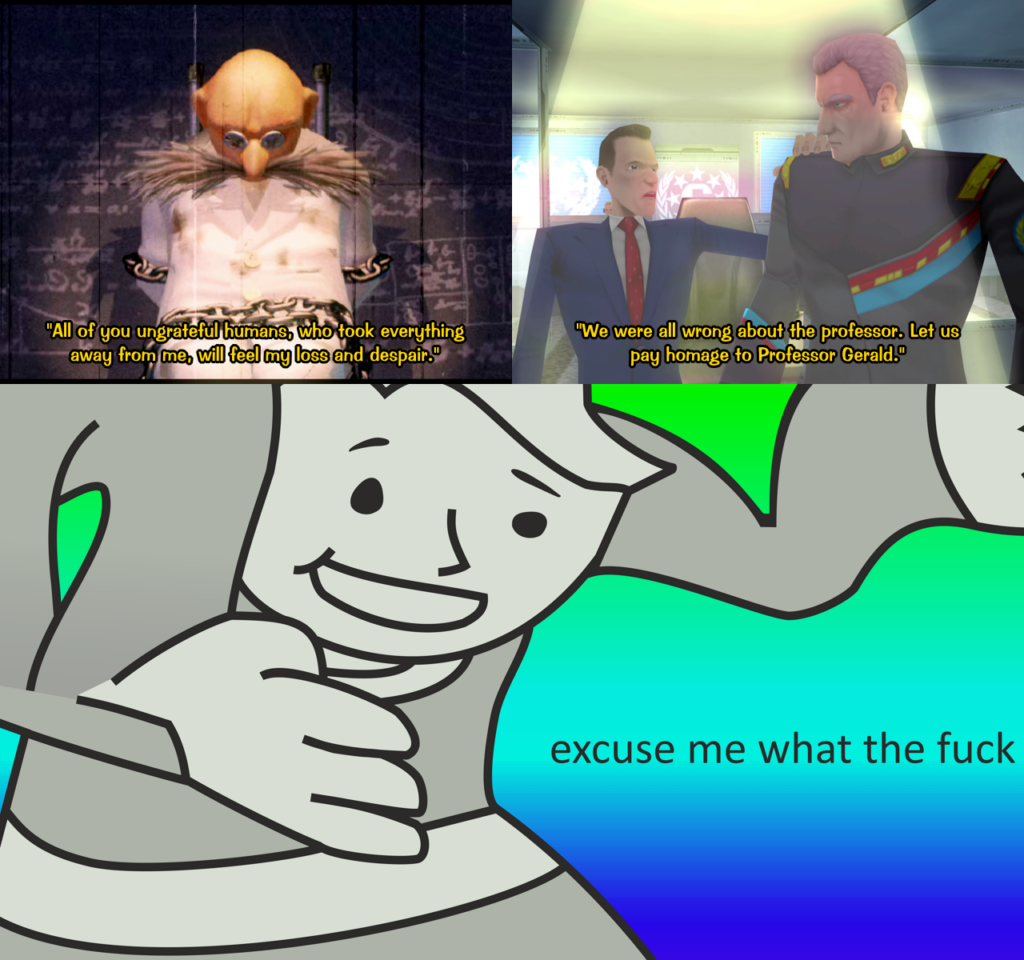
The second comparison will be made to… well… Gerald Robotnik from the Sonic franchise, of all characters, and let me explain why. See, even less sympathetic iterations of Harley from The Animated Series to Lee Bermejo’s works have managed to add some somber elements to her backstory, but they still understand that her despicable actions far outweigh her limited moral compass, as well as that she gave up her promising career in mental health the second she pledged her loyalty to Joker. See, even though Sonic Adventure 2, the debut of Professor Gerald, is written with a recurring sense of melodramatic cheese (which works just fine for a family-friendly sci-fi cartoon game), his descent into madness as the result of blaming his own research for his granddaughter and fellow scientists’ deaths brings a legitimately sad and unnerving tone to the last story. Granted, regardless of how responsible the military was for his grievances, the story remains laser-focused (no pun intended, I promise) on the current conflict, which is that Gerald set up a protocol that’s now poised to destroy the entire human race with all of the Chaos Emeralds collected. Furthermore, Shadow’s completed arc sees him rejecting his creator’s ultimate intent by saving the planet from this very protocol, so the story clearly knows how far to push its sympathies for Gerald.
“I must destroy all the evil the professor has created!”
– Straightforward writing in its simplest, sugariest form.
Though, then again, that’s not to say the last story goes on to flip off Gerald entirely, as an exchange between Eggman and Tails during the end credits shows.
“I looked up to my grandfather because of all the great things he accomplished in his life. He was my hero, and I wanted to be a great scientist like him, but… did he really mean to destroy us?”
– A world-conquering egotist.
So, yeah… very silly game, very corny writing, very strong understanding of morality. Now, fast-forward to Shadow the Hedgehog, and after the defeat of Black Doom and his alien army (i.e., the only interesting characters in the game), the United Federation recalls how Gerald knew and sent a warning to Shadow that the Black Arms would invade before deciding that they were “all wrong about the professor” and should honor his legacy… completely throwing away the notion that this was clearly delivered before he set up his protocol and promised the annihilation of humanity seconds before his execution. So, thanks for deciding you should probably take responsibility for the ARK incident, but… he’s still guilty as sin. Unfortunately, it appears that the “Harley Quinn syndrome” is as infectious and paralyzing as the nerve gas Black Doom releases into the atmosphere.
So, here comes the third comparison, the darkest and only real-world example thus far, as well as the one I discussed in my video. That would be to a man named Peter Scully, a conman on the run from the Australian authorities who fled to the Philippines to produce child exploitation and torture videos to be sold on the dark web. He had multiple young girlfriends who aided in numerous projects of his, one of whom was named Carmen Ann Alvarez. When Scully basically had two young girls dig their own graves, Alvarez suddenly felt sympathy for them and decided to set them free while Scully was away. Both girls ended up helping Filipino authorities trace Scully’s movements and eventually arrest him, leading to him receiving a life sentence. Now, this is a real story, unlike anything involving Harley, but it’s nonetheless comparable as it’s about an accomplice who aided in the most sickening acts that could ever be performed on a child on countless occasions (possibly the worst of Scully’s films, Daisy’s Destruction, has an entire dark web saga behind it) before randomly deciding to show mercy on two kids in particular. In DC canon, Harley has rescued Robin at least twice, but using that to call her a misunderstood soul is too absurd a moral fallacy for the scales of justice. I get the innate feeling that the blind judge would be given a hernia from attempting to balance the evidence against her.
You Two Deserve Each Other
I always found the on-and-off relationship between these two nutcases at the very least unique (certainly more so than her romance with Ivy despite the obvious LGBTQ+ appeal behind it) as well as reflective of both partners’ mental instability, given how many times they’ve narrowly failed to murder each other, but I’d never go as far as to say you can’t have one without the other. Harley’s temporarily separated herself from Joker plenty of times already, and Joker had been around for more than sixty years before Harley even existed, not to mention his past accomplices like Gaggy and Bob, his “number-one guy” from Tim Burton’s Batman. In general, though, it seems like the association between the two will continue to live on among readers and writers alike, especially with the upcoming Joker sequel starring Lady Gaga that has successfully piqued my interest as an old-school Hollywood musical with elements of a psychological thriller. Oh, and also that audio… podcast… series… thing. I don’t plan on listening into that, but I appreciate that it’s maintaining a critical aspect of Harley Quinn as a character that’s suffered as the result of just a little too much political correctness. Again, this is still a sufficiently woke mindset being upheld here.

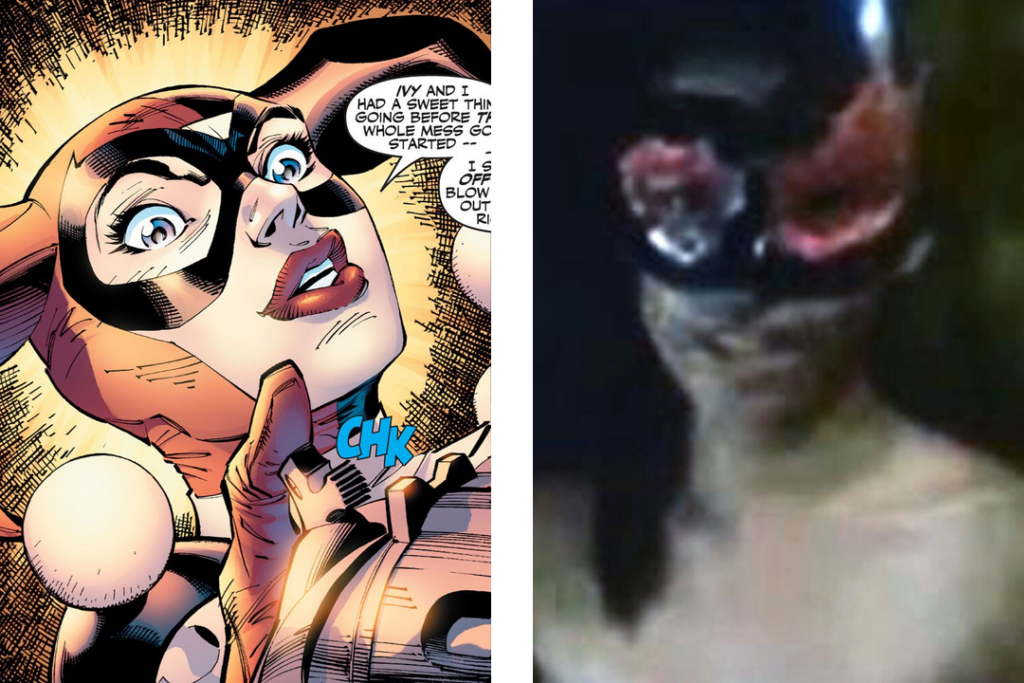
Ugh… you know, I’ve never been a fan of turning Harley and Ivy’s friendship into a straight-up romance, but because it had been brewing since the first season of The Animated Series, it at least feels earned to some degree. Now, I’m not presently up-to-speed on the Rebirth timeline (whether that’s thanks to Joker War, Punchline, The Batman Who Laughs, Bruce Wayne’s clone, the inexplicable return of Thomas Wayne’s Flashpoint Batman, newcomers like Ghost-Maker who are primarily dependent on neat physical designs, or Joker’s severed head in a jar becoming the next Robin, I have no fucking idea), but I am aware of a blossoming and considerably less socially progressive romance between her and… Booster Gold? Yes, the pathetic, entitled jock of the Justice League who may as well have originated as an unused character from The Boys. I’ve seen a few pages of that… and that’s all I’m going to bother with for my own emotional cleanliness. Seeing an unhinged, Brooklyn-accented Joker henchwoman literally pulled from a ’60s soap opera get inserted into a sappy tween romance, like an embarrassing private fanfiction that DC actually published… I’m not aiming to slam the authors of Rebirth when I say that it makes me physically squirm in my seat. It surpasses both cringe and second-hand embarrassment in a way that simply cannot be understated.
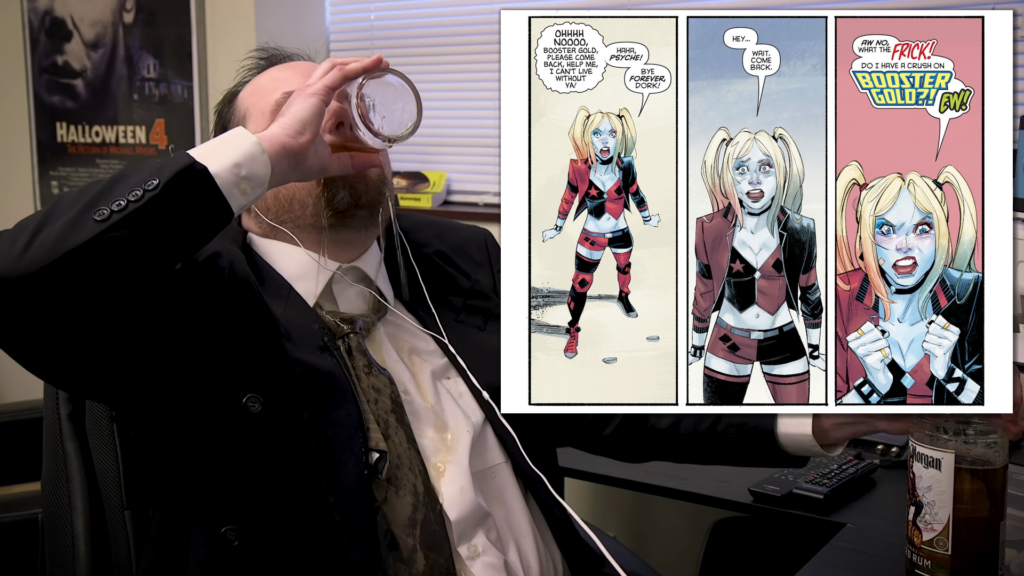
I have to go now. Until Harley goes back to her old ways for the thousandth time and Rebirth starts making sense, I’m raiding the local ICE armory for a grenade launcher. Figure these two clowns would approve of that suicide method.
Leave a Reply